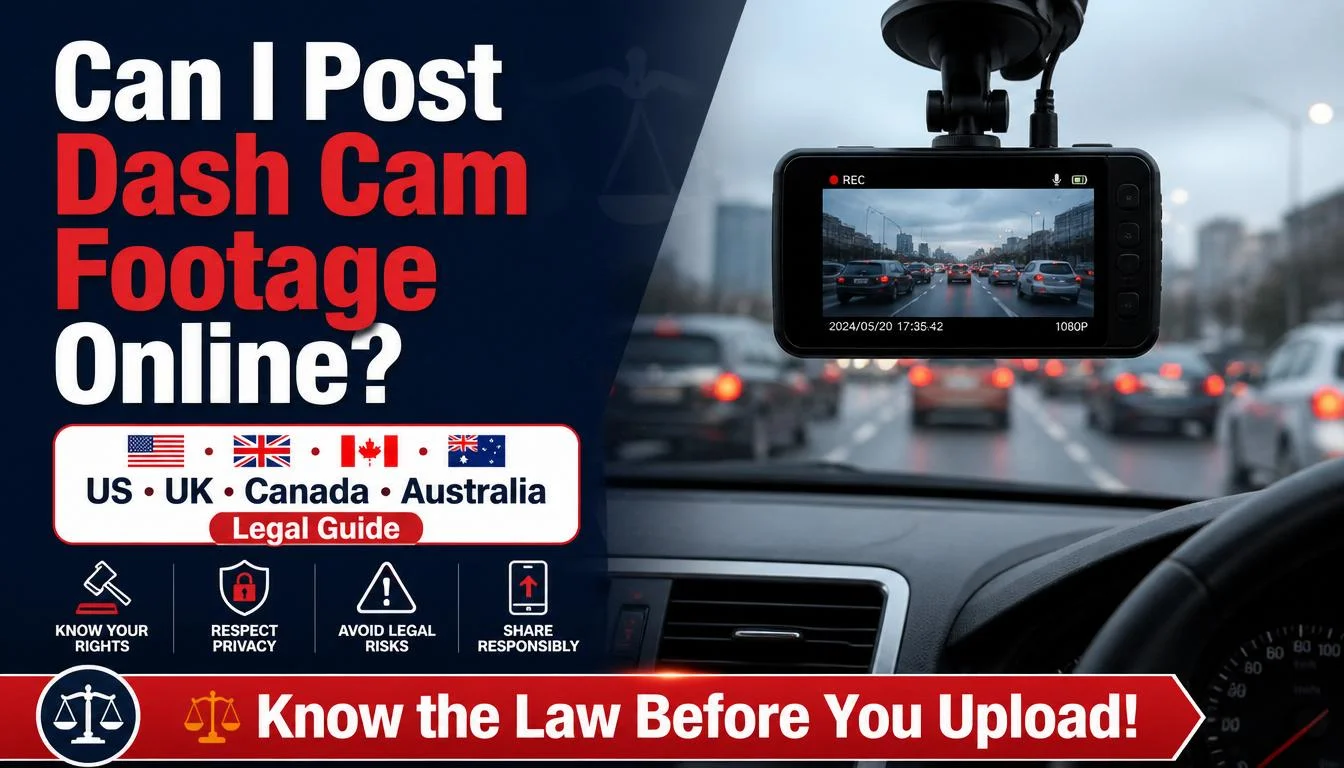
Quick Answer: Generally, yes, you can post dash cam footage online if it was recorded in a public space where there is no “reasonable expectation of privacy.” However, strict privacy laws in the UK, Canada, and parts of Australia often require you to blur faces and license plates before uploading. In the USA, you must also be careful about audio recording laws depending on your state.
Dash cams are no longer just tools for insurance claims; they are content-generating machines. From exposing reckless drivers to capturing hilarious roadside moments and unbelievable meteor strikes, dash cam footage is taking over platforms like YouTube, Reddit, and TikTok.
But before you hit “upload” on that crazy highway encounter, you need to ask a critical question: Is it legal to post dash cam footage online?
Because privacy laws vary significantly across the US, UK, Canada, and Australia, uploading unedited videos could lead to heavy fines, platform bans, or even civil lawsuits. This comprehensive guide will walk you through everything you need to know to share your footage safely, legally, and profitably.
The Short Answer: Is it Legal to Post Dash Cam Footage?
In most democratic countries, recording video in a public space (like a highway, city street, or public parking lot) is entirely legal. This is because people driving on public roads do not have a “reasonable expectation of privacy.”
However, recording the footage and publishing it online are two completely different legal matters. Problems arise when:
- You record audio inside your car without your passengers’ consent.
- You capture identifiable information (like faces and license plates) in regions protected by strict data privacy laws.
- You upload the video with the intent to harass or defame someone.
Let’s break down the specific rules based on where you live.
Country-Specific Dash Cam Laws
If you want to stay out of legal trouble, you need to follow the specific privacy guidelines of your country.
Dash Cam Laws in the USA
In the United States, the First Amendment strongly protects your right to record video in public spaces. You can legally post dash cam footage of public roads online. However, the trap lies in the audio.
- Audio Consent Laws: Dash cams often record conversations inside the cabin. Some states (like New York) are One-Party Consent states, meaning as long as you are part of the conversation, you can record it. However, 11 states (including California, Florida, and Washington) are Two-Party Consent states. If you record a passenger’s voice without their permission and post it online, you are breaking the law.
Dash Cam Laws in the UK
The UK has incredibly strict data protection laws governed by the GDPR and enforced by the ICO (Information Commissioner’s Office).
- Under UK law, dash cam footage that captures identifiable individuals or vehicle registration plates is considered “Personal Data.
- While using a dash cam for personal security is fine, publishing unedited footage to social media without the consent of the people in the video is a breach of the GDPR. To legally post footage in the UK, you must blur faces and license plates.
Dash Cam Laws in Canada
Canada operates under PIPEDA (Personal Information Protection and Electronic Documents Act).
- Similar to the UK, Canadians have a right to privacy. While recording public roads is generally accepted, uploading identifiable information (like a clear shot of someone’s face through their windshield) without consent can violate federal privacy acts.
- Furthermore, Canada has strict laws against recording private audio without consent. It is highly recommended to mute your dash cam’s interior microphone.
Dash Cam Laws in Australia
In Australia, dash cam legality falls under the Surveillance Devices Act, which varies drastically by state.
- In New South Wales (NSW) and Victoria, you can generally record video on public roads and post it.
- However, in states like Western Australia and South Australia, publishing footage that captures a private conversation or identifiable individuals without their consent can lead to severe legal penalties. Always blur identifying details before posting on Australian social media.
What Needs to be Edited Before Uploading?
To protect yourself from privacy complaints and copyright strikes, you should always run your video through basic editing software before posting it to the internet.
1. Muting the Audio
Unless the audio is absolutely vital to the context of the video (e.g., the sound of screeching tires), you should strip the audio track entirely. This protects you from violating two-party consent laws regarding cabin conversations and prevents you from accidentally broadcasting private phone calls. Furthermore, if the radio was playing in the background, muting the audio saves you from a DMCA copyright strike on YouTube or Facebook.
2. Blurring Faces and License Plates
Using a license plate blurring software or basic video editing tools to obscure faces and vehicle tags is the safest way to publish. Once identifying markers are removed, the video is generally considered anonymous and safe to post worldwide.
Where Are You Posting the Footage? (Purpose Matters)
Submitting to Police or Insurance Companies
If you capture an accident or a crime, submitting the unedited, raw footage to your insurance provider or local law enforcement is 100% legal and encouraged. In fact, police portals rely on this unedited data to solve crimes. This is considered a private, legal transfer of information.
Uploading to YouTube, Reddit, Facebook, or TikTok
When you upload to public platforms, you are bound by both local laws and the platform’s Community Guidelines. Subreddits like r/IdiotsInCars or YouTube compilation channels thrive on this content, but if a user reports your video for a privacy violation, the platform can remove your video or ban your account.
Posting Car Crash vs. Regular Driving Footage
Not all footage is treated equally by social media algorithms or the law.
Social Media Community Guidelines
A video of a driver running a red light is harmless to post. However, uploading footage of a severe, violent car crash can violate “Graphic Content” policies on TikTok, Instagram, and YouTube.
The Danger of Posting Fatal Accidents
You should never post footage of an accident where someone is severely injured or killed. Not only is this highly unethical and distressing to the victims’ families, but it can also interfere with active police investigations. If authorities discover you published evidence of a fatal crash before a trial, you could face legal consequences for impeding an investigation.
Can I Sell or Monetize My Dash Cam Footage?
Yes! Many drivers make money by licensing their crazy dash cam captures.
Who Owns the Copyright?
You do. As the person who set up the camera and captured the footage, you own the exclusive copyright to that video.
Dealing with News Agencies and Viral Channels
If you capture a meteor, a wild animal, or a dramatic multi-car pileup, news agencies (like CNN, BBC) or viral YouTube compilation channels may contact you. Do not give it away for free. You can sign a media licensing agreement to get paid for your footage. Be wary of companies asking you to sign away your exclusive rights forever—opt for non-exclusive licensing if possible.
Monetizing on YouTube
If you start your own dash cam channel, you can monetize it through the YouTube Partner Program. Just ensure you mute copyrighted radio music and blur license plates to avoid demonetization.
Risks of Posting Dash Cam Footage Illegally
If you ignore privacy laws and post raw footage out of anger, you expose yourself to several risks:
- Defamation & “Naming and Shaming”: If you post a video clearly identifying a driver and their license plate, accompanied by text accusing them of a crime (e.g., “This guy is a drunk driver!”), they can sue you in civil court for defamation if your claim is unproven.
- Fines: In the UK and parts of the EU, GDPR violations can result in heavy financial penalties.
- Retaliation: Exposing someone online can lead to road rage incidents or cyberbullying directed back at you.
5 Best Practices for Sharing Dash Cam Videos Safely
Follow this quick checklist before you hit publish:
- Check local privacy laws regarding audio consent and public recording.
- Always mute cabin audio to protect private conversations and avoid music copyright strikes.
- Blur identifying information like faces, license plates, and company logos on work trucks.
- Never post fatal crashes or footage related to an active police investigation.
- Don’t post for harassment. Avoid “naming and shaming” to protect yourself from defamation lawsuits.
Frequently Asked Questions (FAQs)
Can I use dash cam footage to report a bad driver?
Yes. Most modern police departments have online portals where you can securely upload unedited footage of reckless driving. Handing footage over to the police is legally protected.
Will my insurance company accept unedited dash cam footage?
Absolutely. Insurance companies prefer raw, unedited footage with the original timestamp to process claims accurately. Do not blur anything if you are sending it directly to your insurance agent.
Can I be sued for defamation for posting a bad driver’s video?
Yes, if you identify the driver (via face or license plate) and make false or unproven malicious claims about them (like accusing them of being intoxicated), they can pursue a civil lawsuit against you for defamation or libel.
Can police confiscate my dash cam?
In most jurisdictions (including the US and UK), police cannot simply seize your dash cam without a warrant unless they have reasonable grounds to believe it contains evidence of a serious crime, and that the evidence might be destroyed if they don’t take it immediately.
Disclaimer: The information provided in this article is for educational and informational purposes only and does not constitute legal advice. Privacy and copyright laws change frequently and vary by jurisdiction. Always consult with a qualified attorney in your local area regarding specific legal issues related to your dash cam footage.

Tony Kilmer is an auto mechanic and the author behind CarTruckAdvisor.com. He shares practical, no-nonsense guidance on car and truck maintenance, common problems, and repair decisions—helping drivers understand what’s going on and what to do next.