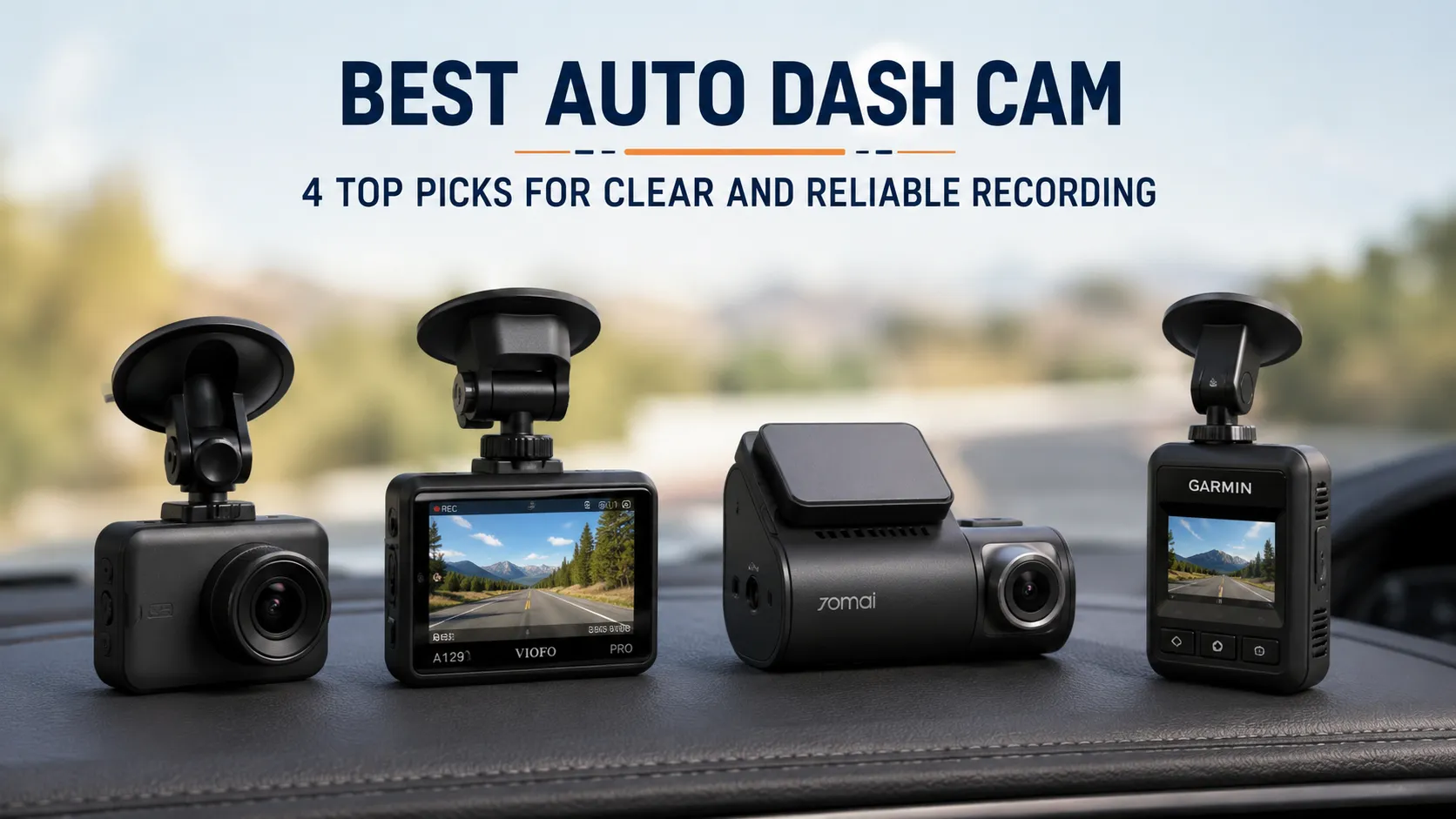
A dependable dash cam can provide a clear record of unexpected incidents, close calls, parking impacts, and memorable road trips. The challenge is choosing the right model from dozens of cameras that promise sharp video, reliable night recording, simple mobile access, and useful parking protection.
The best auto dash cam is not necessarily the model with the longest feature list. It is the camera that matches your driving situation. A daily commuter may need discreet front-and-rear recording, while a rideshare driver may need front, cabin, and rear coverage. Other drivers may value a compact design, included memory card, or stronger low-light performance.
For this guide, we compared four well-known dash cams currently listed on Amazon. We focused on recording coverage, image resolution, night-time capability, GPS and Wi-Fi features, parking-mode requirements, installation complexity, and overall use-case value. Prices and availability can change, so check the Amazon listing for the latest details before ordering.
Affiliate Disclosure: As an Amazon Associate, we earn from qualifying purchases. This does not affect our product selection or editorial opinions.
| Product Image | Product Name | Best For | Recording Setup | Check Price |
|---|---|---|---|---|

Credit: Amazon |
VIOFO A229 Pro 2CH | Best Overall | 4K Front + 2K Rear | CHECK PRICE |

Credit: Amazon |
Vantrue N4 Pro | Best for Rideshare Drivers | 4K Front + 1080p Cabin + 1080p Rear | CHECK PRICE |

Credit: Amazon |
REDTIGER F7NP | Best Value Front-and-Rear Option | 4K Front + 1080p Rear | CHECK PRICE |

Credit: Amazon |
Garmin Dash Cam Mini 3 | Best Compact Dash Cam | 1080p Front | CHECK PRICE |
Our Top Auto Dash Cam Picks
1. VIOFO A229 Pro 2CH — Best Overall
The VIOFO A229 Pro 2CH is a strong all-around choice for drivers who want high-resolution recording at both ends of the vehicle. Its front camera records in 4K, while the rear camera records in 2K. That higher rear resolution gives it an advantage over many dual-camera systems that pair a 4K front unit with a basic 1080p rear camera.
The system uses STARVIS 2 sensors for the front and rear cameras and supports HDR recording. These features are designed to improve detail when the road contains both bright and dark areas, such as headlights at night, shaded streets, tunnels, or strong sunlight. Built-in GPS can add route, speed, location, and time information to footage, while 5GHz Wi-Fi allows faster access through the VIOFO mobile app.
Pros
- 4K front and 2K rear recording provide strong two-channel detail.
- STARVIS 2 sensors and HDR support help in difficult lighting.
- Built-in GPS records useful trip information.
- 5GHz Wi-Fi makes previewing and transferring clips more convenient.
- Voice commands reduce the need to touch the camera while driving.
- Buffered parking recording is available with the correct power setup.
Cons
- A compatible hardwire kit is required to use its full parking-mode capability.
- It does not include a cabin-facing camera.
- The advanced settings may take longer to learn than those of a basic dash cam.
- You may need to purchase a compatible high-endurance microSD card separately, depending on the bundle selected.
Our Honest Take
The VIOFO A229 Pro 2CH is the best auto dash cam in this group for drivers who prioritise front-and-rear video quality. It offers a useful balance of sharp recording, GPS data, Wi-Fi access, voice control, and parking options without forcing the buyer into a three-camera system.
It is especially suitable for commuters, road-trip drivers, and vehicle owners who want better rear-camera detail. The main limitation is that full parking protection requires additional installation hardware. However, if your priority is dependable two-channel coverage rather than interior recording, this is the most complete choice among our four picks.
2. Vantrue N4 Pro — Best for Rideshare Drivers
The Vantrue N4 Pro is built for drivers who need more than front-and-rear coverage. It records the road ahead, the vehicle interior, and the road behind at the same time. In its three-channel mode, the front camera records up to 4K while the interior and rear cameras record at 1080p.
This coverage is particularly useful for Uber, Lyft, taxi, delivery, or family drivers who want a record of activity inside the cabin as well as outside the vehicle. The cabin camera uses infrared LEDs to record passengers in dark conditions. The system also includes GPS, Wi-Fi, voice commands, loop recording, a G-sensor, and several parking modes.
Pros
- Three-channel recording covers the front, cabin, and rear simultaneously.
- 4K front recording provides strong forward-facing detail.
- Infrared cabin lighting supports interior recording at night.
- Built-in GPS and Wi-Fi improve trip logging and clip access.
- Voice commands allow common actions without reaching for the camera.
- Multiple parking modes provide flexible monitoring options.
- Supports high-capacity memory cards for longer recording periods.
Cons
- Installing and hiding cables for three cameras takes more time.
- The rear and cabin cameras record at 1080p rather than 2K or 4K.
- A separate hardwire kit is needed for continuous parking-mode use.
- Three-channel files use storage faster than a single-camera system.
Our Honest Take
The Vantrue N4 Pro is the most practical choice in this guide for rideshare and commercial drivers. Its cabin-facing camera can provide valuable context that a normal dual dash cam cannot capture. It is also a sensible option for parents who want broader coverage during family trips.
The trade-off is installation complexity. There are more cameras, more wiring, and more video files to manage. Drivers who only need front-and-rear coverage may find the VIOFO system simpler. For anyone who regularly carries passengers, however, the Vantrue N4 Pro provides the most complete viewing coverage.
3. REDTIGER F7NP — Best Value Front-and-Rear Option
The REDTIGER F7NP is designed for buyers who want a feature-rich front-and-rear system without immediately moving into the premium price range. It records in 4K at the front and 1080p at the rear, with a wide viewing angle intended to capture more of the road around the vehicle.
Its feature list includes a STARVIS 2 sensor, WDR and HDR processing, built-in GPS, 5.8GHz Wi-Fi, app control, loop recording, and collision-triggered file locking. The listed package also includes a memory card, which can make the initial setup easier for buyers who do not already own compatible storage.
Pros
- 4K front and 1080p rear recording cover both directions.
- A memory card is included with the listed package.
- Built-in GPS records route, speed, location, and time information.
- Fast Wi-Fi supports app-based video review and downloading.
- WDR, HDR, and a large-aperture lens support low-light recording.
- Loop recording automatically manages older unlocked files.
- Supercapacitor construction is better suited to temperature changes than many battery-based designs.
Cons
- The rear camera is limited to 1080p.
- The larger screen is less discreet than a compact screenless camera.
- Continuous parking monitoring requires a compatible hardwire kit.
- Wide-angle footage can make distant objects appear smaller.
Our Honest Take
The REDTIGER F7NP offers one of the easiest ways to get front-and-rear recording, GPS, Wi-Fi, app access, and an included card in one package. It is a practical choice for first-time dash cam buyers who want useful features without the complexity of a three-channel system.
Its rear camera does not provide the same resolution as the VIOFO A229 Pro, but the complete package may offer better value for many everyday drivers. It is well suited to commuting, motorway driving, road trips, and general accident documentation.
4. Garmin Dash Cam Mini 3 — Best Compact Dash Cam
The Garmin Dash Cam Mini 3 is designed for drivers who want a camera that is easy to hide behind the rear-view mirror. Its key-sized body records 1080p video through a 140-degree field of view and automatically saves footage when an incident is detected.
A built-in polarising lens helps reduce windshield glare, while voice control allows the driver to save video or manage audio without touching the device. Saved clips can be viewed through the Garmin Drive app. Garmin also offers optional cloud-based Vault features, although some remote and parking functions require a paid subscription, constant power, and an active Wi-Fi connection.
Pros
- Very small design is easy to position discreetly.
- Simple automatic recording suits drivers who do not want a complex interface.
- Built-in polariser reduces reflections from the windshield.
- Voice commands allow hands-free control of common functions.
- The Garmin Drive app supports viewing and sharing saved clips.
- Multiple Garmin cameras can be synchronised through the app when purchased separately.
Cons
- 1080p resolution provides less detail than the 4K models in this guide.
- It only records the front unless additional cameras are purchased.
- The camera has no built-in display for reviewing footage directly.
- Some cloud, remote-view, and parking features require a paid Vault subscription and additional connectivity.
- A constant-power installation may be needed for parking monitoring.
Our Honest Take
The Garmin Dash Cam Mini 3 is the best choice here for drivers who care more about discretion and simplicity than maximum resolution. It nearly disappears behind the mirror, starts recording automatically, and avoids adding a large screen to the windshield.
It is not the right model for buyers who want the sharpest plate detail, built-in rear coverage, or a screen. However, it is a convenient front-facing camera for drivers who want a recognised brand, a compact body, voice control, and app-based clip management.
Buyer’s Guide: 5 Key Factors to Consider
1. Decide How Many Camera Channels You Need
A one-channel dash cam records the road ahead. This is the simplest and least complicated setup, but it cannot show what happened behind the vehicle. A two-channel system adds a rear camera and is the best choice for many private drivers. A three-channel system adds a cabin camera, making it more useful for rideshare, taxi, delivery, and passenger-carrying vehicles.
Choose coverage before comparing smaller features. There is little value in buying a premium front-only camera if the incident you want to document happens behind the car.
2. Compare Real Recording Resolution
Resolution affects the amount of visual detail a camera can record, but the number printed on the box is only part of the story. Sensor quality, lens quality, exposure control, HDR processing, windshield glare, motion, distance, weather, and lighting also affect the final result.
A 4K front camera generally provides more detail than a 1080p model, especially when zooming into a frame. However, no dash cam can guarantee that every licence plate will be readable in every condition. Look at the resolution of every channel, not just the front camera.
3. Check Night-Time and High-Contrast Performance
Many incidents happen in poor lighting. Features such as STARVIS 2 sensors, HDR, WDR, a wider lens aperture, and a polarising filter can help a camera manage headlights, streetlights, shadows, reflections, and bright skies.
For cabin recording, infrared LEDs are useful because they allow the interior camera to record passengers in very dark conditions. For exterior recording, good exposure control is usually more important than an aggressively wide viewing angle.
4. Understand Parking Mode Before Buying
Parking mode can record motion, impacts, time-lapse footage, or buffered clips while the vehicle is parked. However, most dash cams cannot provide full parking monitoring through a standard socket that switches off with the ignition.
You will usually need a compatible hardwire kit or another constant-power source. A properly designed kit should include low-voltage protection to reduce the risk of draining the vehicle battery. Check whether the required cable is included or sold separately.
5. Plan for Storage, Wi-Fi, GPS, and Installation
Higher resolution and additional camera channels create larger files. Use a compatible high-endurance microSD card because dash cams continuously overwrite footage. Check the manufacturer’s maximum supported capacity and recommended card specification.
Wi-Fi helps you change settings and download clips to a phone, while GPS can record route, speed, location, and time information. Also consider the physical installation. Rear and cabin cameras require more cable routing, and a neat hardwired installation may be worth professional help if you are not comfortable working around trim panels or fuse boxes.
Frequently Asked Questions
What is the best auto dash cam for most drivers?
The VIOFO A229 Pro 2CH is our best overall choice because it combines 4K front recording, 2K rear recording, dual STARVIS 2 sensors, HDR, GPS, Wi-Fi, voice control, and several parking options. Drivers who need interior coverage should consider the Vantrue N4 Pro instead.
Is a 4K dash cam worth buying?
A 4K dash cam is worth considering when you want more forward-facing detail and expect to zoom into saved frames. It is especially useful for motorway driving and complex road scenes. The trade-offs are larger files, higher storage use, and often a higher purchase price.
Is a front-and-rear dash cam better than a front-only model?
For most drivers, front-and-rear coverage provides a more complete record of an incident. A rear camera can capture tailgating, rear impacts, and events that happen after a vehicle passes the front camera. A front-only camera remains suitable when simplicity, low cost, or a discreet installation is the main priority.
Do dash cams record when the car is turned off?
Some dash cams can record while the vehicle is parked, but they normally need a compatible hardwire kit or another constant-power source. Parking features vary by model and may include impact detection, motion detection, buffered recording, low-bitrate recording, or time-lapse recording.
How much memory does a dash cam need?
The right capacity depends on resolution, frame rate, the number of cameras, driving time, and how often you save clips. A three-channel 4K system fills storage faster than a single 1080p camera. Use a high-endurance card within the capacity supported by the manufacturer, and format it regularly according to the product instructions.
Can a dash cam drain the car battery?
A dash cam can drain the battery if it receives constant power without suitable voltage protection. For parking mode, use a compatible hardwire kit with a low-voltage cutoff and follow the manufacturer’s installation guidance. Drivers who rarely use their vehicles should be especially careful with continuous parking recording.
Where should an auto dash cam be mounted?
The front camera should normally be positioned high on the windshield, close to the rear-view mirror, without blocking the driver’s view. The lens should have a clear view through the wiper-cleaned area of the glass. Mounting and recording rules vary by location, so check the laws that apply where you drive.
Final Verdict: Which Auto Dash Cam Should You Buy?
The VIOFO A229 Pro 2CH is the best overall option for drivers who want high-quality front-and-rear recording. Its 4K front and 2K rear setup, dual STARVIS 2 sensors, HDR, GPS, Wi-Fi, and voice control make it the most balanced system in this comparison.
The Vantrue N4 Pro is the better choice for rideshare and passenger-carrying vehicles because it adds an infrared cabin camera. The REDTIGER F7NP offers a practical value package with front-and-rear coverage, GPS, Wi-Fi, and an included card. The Garmin Dash Cam Mini 3 is best for drivers who want a small, simple camera that stays out of sight.
Your final choice should depend on the areas you need to record, the level of detail you expect, whether you need parking protection, and how much installation work you are willing to complete.
Availability Notice: Product specifications, bundles, prices, and availability may change. Review the current Amazon product page before purchasing.

Tony Kilmer is an auto mechanic and the author behind CarTruckAdvisor.com. He shares practical, no-nonsense guidance on car and truck maintenance, common problems, and repair decisions—helping drivers understand what’s going on and what to do next.